
Strengthening Project Coaching through
Future-Oriented Techniques
An Adult Learning Collaboratory (ALC) collaboration with Centre for Healthcare Innovation (CHI), NHG Health

The Challenge
NHG Health’s Centre for Healthcare Innovation (CHI) wanted to strengthen their coaching practice by embedding robust pedagogical approaches in their programmes.
To that end, they partnered with the Adult Learning Collaboratory (ALC) to explore how future-oriented techniques could create deeper reflection, broader participation, and more collaborative problem-solving in the Designing Human-Centred Care (DHCC) programme.

The Approach
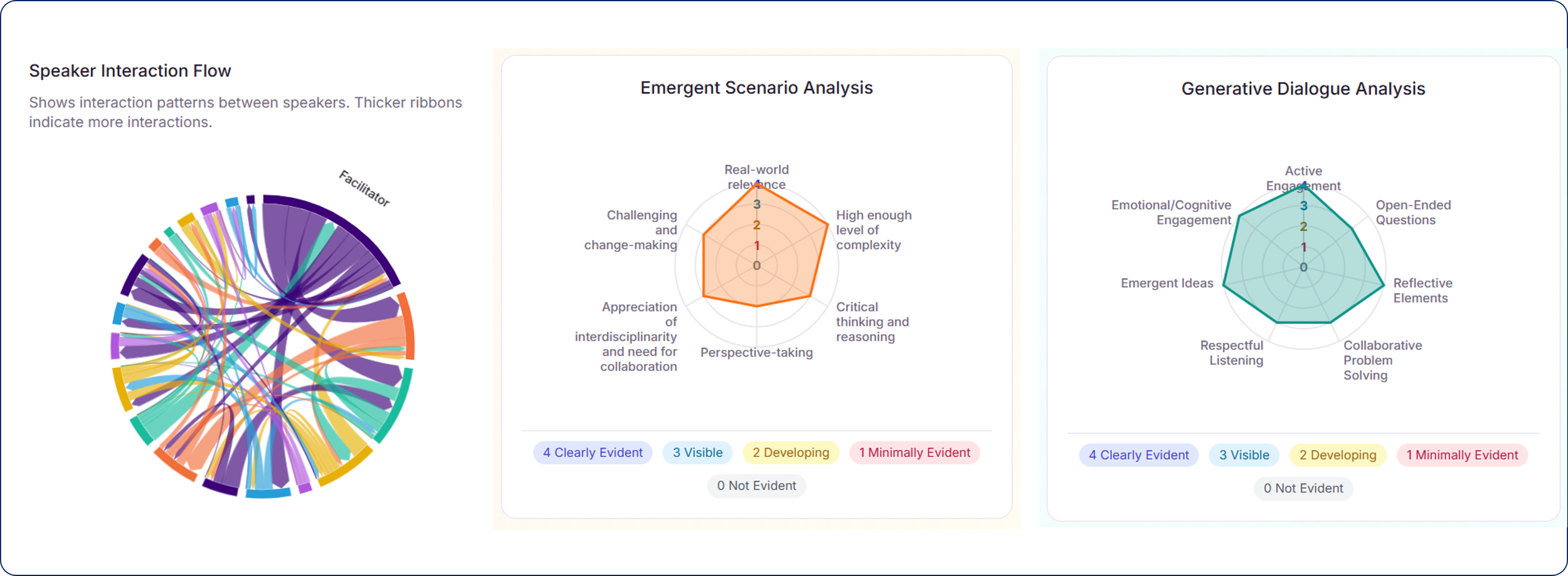
Coaches focused on generative dialogue as a future-oriented technique to support project coaching.
Through their facilitation, the coaches encouraged deep discussion, helping teams examine assumptions, surface perspectives, and reflect collectively on their reasoning.
The coaches trialled the approach after the second coaching session and continued to do so over six months. During this period, they used an AI-based Analyser to review audio-recorded sessions and reflect on their coaching practice.
6
Months’ Experiment
6
Project Teams
6
Coaches
The Analyser visualised interaction patterns within the coaching conversations, helping coaches identify where participation, inquiry, and reflective dialogue could be further strengthened.
What Happened
Future-oriented techniques were adopted across the coaching cycle, though implementation became more uneven as project delivery pressures intensified.
In earlier sessions, coaches created greater space for inquiry and discussion.
However, as projects moved closer to presentations and completion milestones, increasing pressures made conversations more task-focused and time-constrained.
Considering these realities, we surfaced several factors that could strengthen future-oriented coaching:
Supporting coaches through analyser feedback and peer reflection.
Introducing future-oriented techniques from the first session.
Reviewing how time is allocated for exploration and dialogue.
Outcomes
Coaches were motivated, capable, and demonstrated strong deep-learning.
The experiment illuminated the programme conditions needed for future-oriented techniques to successfully strengthen project coaching. The findings suggest that for future-oriented practices to be sustained successfully, coaches require sufficient time and space within project workflows to engage in inquiry, dialogue, and reflection alongside delivery demands.
Key Takeaway
Introduce future-oriented techniques from the start.
This experiment showed that future-oriented coaching requires not only training in new techniques, but also programme design that creates protected space for inquiry. By introducing the techniques from the start, project coaching can move beyond milestone delivery to support more adaptive, collaborative, and future-oriented ways of working.
Step Into Our Space.
Start the conversation with us. Let’s drive innovative learning solutions together.