
Strengthening
Facilitation through
Future-Oriented Techniques
An Adult Learning Collaboratory (ALC) collaboration with Capelle Consulting.
About
The Challenge
Capelle Consulting is a management consultancy specialising in organisational development and human capital, with three practice arms spanning consulting, training and coaching.
A Certified B Corporation, Capelle partners with clients from diagnosis to implementation, with some client relationships extending more than two decades.
As business environments grow more complex and learner profiles continue to shift, Capelle recognised that facilitation methods built around knowledge transfer were no longer sufficient on their own.
To that end, they partnered with the Adult Learning Collaboratory (ALC) to explore how future-oriented techniques could help move their facilitation techniques beyond traditional approaches into more productive and collaborative dialogue, enabling learners to navigate and adapt to changing environments effectively.

The Approach
Facilitators drew on the techniques of emergent scenarios and generative dialogue to support collaborative sensemaking in their sessions.
As facilitators created more space, learners began doing the work themselves: challenging each other's thinking, drawing on their own experience, and including quieter voices in the conversation.
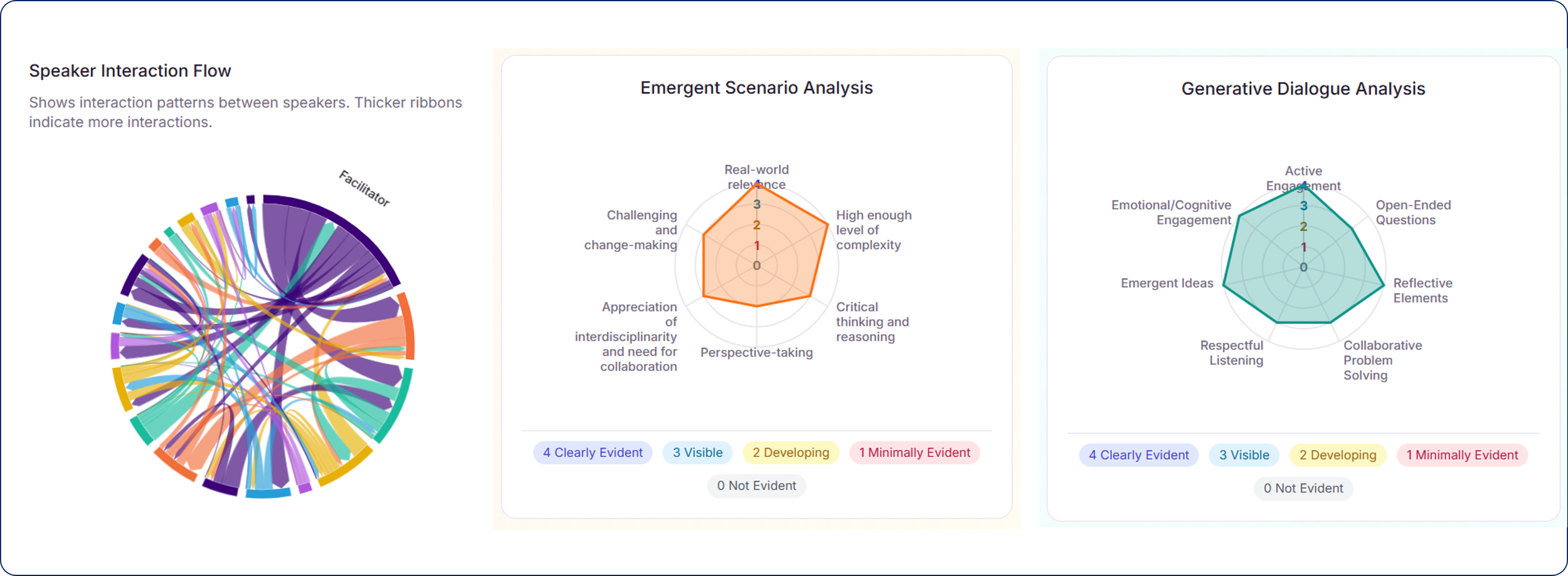
The facilitators trialled the approach over a period of two months. During this period, they used an AI-based analyser to review audio-recorded sessions and reflect on their facilitation.
2
Months
225
Learners
6
Facilitators
Over
The Analyser visualised interaction patterns within the sessions, helping facilitators identify where participation, inquiry, and reflective dialogue could be further strengthened.
What Happened
Future-oriented techniques were adopted across various courses, took time to take root, and worked best in the right learning contexts.
The facilitators showed strong readiness for future-oriented techniques, with high engagement and clear improvements over the sessions.
The relatively short duration of practice, however, may have been insufficient for full benefits to emerge. Moreover, future-oriented techniques appeared more relevant to learning activities involving complex judgement, sense-making and adaptive problem-solving.
Considering these realities, several factors that could strengthen future-oriented facilitation stood out:
Continue to encourage deliberate practice
Allow sufficient time (and sessions ) for future-oriented practice and benefits to emerge
Apply future-oriented techniques in select training contexts, taking participant profile, nature of courses etc, allowable duration of learning activity, etc into consideration
Outcomes
Facilitators were motivated, and demonstrated strong readiness for future-oriented techniques.
The experiment demonstrated that future-oriented techniques work most powerfully as a focused, intentionally designed segment within a broader programme. Where the conditions were right, the shift in room energy was immediate and observable. Peers drew each other in, cross-sector insight surfaced naturally, and the conversation moved forward without the facilitator driving it. What Capelle learned through the experiment now forms a part of how it designs programmes.
Key Takeaway
Future-oriented techniques can be designed into select programmes and facilitation contexts.
Through the collaboration with ALC, Capelle set out to build on its existing facilitation practice to meet evolving learner needs. Capelle is now incorporating these approaches where appropriate.
“ALC treated us as co-creators. We shaped the experiment together, we reviewed the data together, and what we learned is now embedded in how we design programmes. That is a partnership that outlasts the pilot.”
— Ting Siew Lee, Chief Executive Officer, Capelle Consulting
Get in Touch with Capelle
To learn more about Capelle and their offerings, feel free to get in touch with them via the button below.
Step Into Our Space.
Start the conversation with us. Let’s drive innovative learning solutions together.